What Stephen Sondheim taught me about leadership, strategy, and human behavior
Leadership lessons can come from surprising places — like fairy tales, musical theater, and a 30-year-old high school production.
Recently, I saw Into the Woods at the Oregon Shakespeare Festival in Ashland. If you’re not familiar, it’s a mashup of classic Grimm tales, reimagined with brilliant lyrics by Stephen Sondheim and a deeply human script by James Lapine. It’s funny, dark, poetic — and wildly relatable.
Even if you’ve seen the show before, the second act will hit you differently as an adult. Especially if you’ve ever led a team, launched a project, or simply tried to make progress in a chaotic, interconnected world.
It’s a show about goals, consequences, trauma, and truth-telling — in other words, everything we deal with as professionals, leaders, and humans.
The Strategy of Fairy Tales
In Act I, each character is chasing a goal: a child, a prince, a cow, a ball, revenge. But to get what they want, they must interact with others — collaborate, negotiate, or manipulate.
Sound familiar?
When goals depend on other people’s actions, the worst in us tends to surface. We call it “fuckery” — and yes, it’s a Pregame technical term.
Some examples from the fairy-tale workforce:
-
The Baker: shuts down feedback
-
The Baker’s Wife: communicates indirectly
-
Jack: terrible negotiator
-
Little Red: strays from the path
-
The Witch: overcomplicates everything
-
Stepsisters: professional victims
-
Cinderella: avoids conflict
What starts as a whimsical quest quickly devolves into chaos — just like an unaligned team during crunch time.
Then Act II brings a crisis. The stakes are higher. Everyone’s reacting based on their trauma: fight, flight, freeze, or flock. And while most characters spiral, one sees clearly.
The Witch.
She names the problem. She demands realism. She pushes everyone out of denial and into action.
It’s not pretty. But it’s effective.
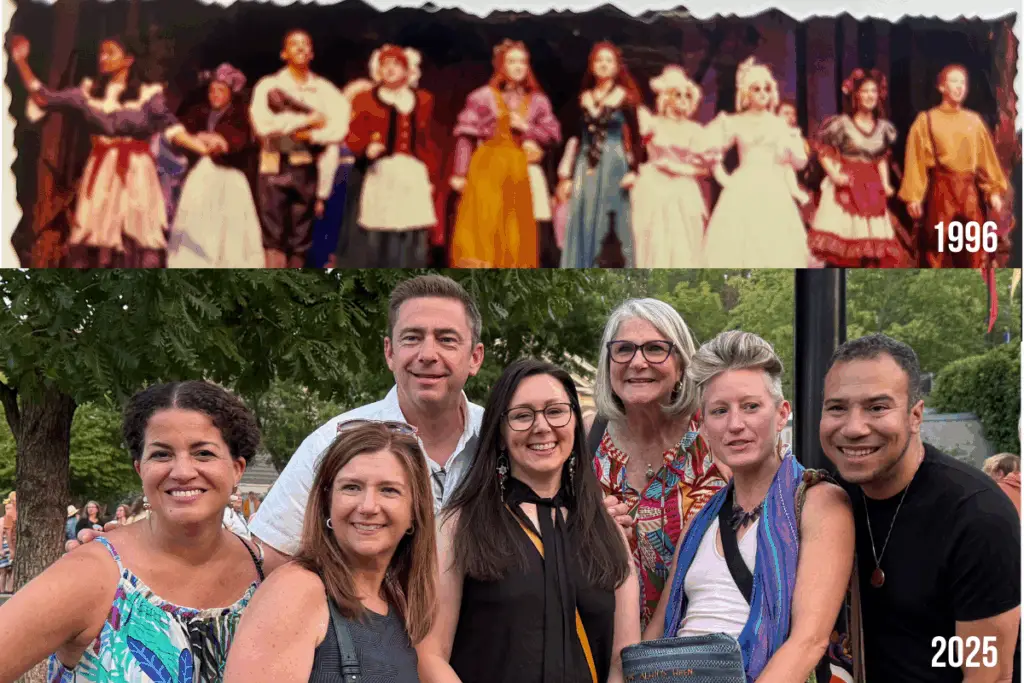
Years ago, I played The Witch in our high school production. Back then, this lyric landed one way:
“You’re so… nice. You’re not good, you’re not bad, you’re just… nice.”
“I’m not good / I’m not nice / I’m just right.”
Now, having coached leadership teams and built strategic plans for companies and communities, I hear it as a leadership truth bomb.
Being nice doesn’t solve problems. Being right — and acting on it — does.
Sondheim Soundbites
Sondheim’s lyrics aren’t just memorable — they’re mantras for navigating life, work, and the mess in between.
Here are a few that have stuck with me over the years:
Over the years, I’ve quoted (okay, sung) Into the Woods lyrics at key moments:
On identity and hard decisions:
“Although how can you know / Who you are till you know / What you want, which you don’t? / So then which do you pick?”
On the far-reaching impact of your actions:
“Careful the things you say / Children will listen / Careful the things you do / Children will see / And learn / Children may not obey / But children will listen / Children will look to you / For which way to turn / To learn what to be…”
On timing:
“Opportunity is not a lengthy visitor.”
On being present:
“Oh, if life were made of moments / Even now and then a bad one—! / But if life were only moments / Then you’d never know you had one.”
Telling Your Leadership Story
At Pregame, we talk a lot about goal-setting, strategy, and leadership. What we don’t always say outright — but Sondheim nails — is that progress requires truth.
Truth about your goals.
Truth about your patterns.
Truth about how you work with others.
Sometimes, you’ve got to go into the woods — the uncomfortable place, the unknown path — to get to your next level. It’s not always a “happily ever after,” but it is the real path forward.
And honestly? That’s more satisfying anyway.
Finale
If you’re navigating a life or career transition, I leave you with a central theme of this story:
Though it’s deep, dark, and fearful, sometimes you have to go into the woods to get to your happy ever after.